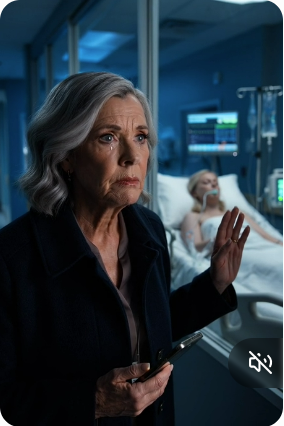
Daniel told her the pregnancy had ended.
She had accepted his word because it was easier than confronting what it might mean about her son.
Trust would not return simply because she was grieving.
But that afternoon, she made no demands.
She didn’t ask the children to call her Grandma.
She asked about their favorite books and listened to their answers.
When Olivia announced that she wanted to become a veterinarian, Margaret smiled and said she had once cared for injured horses on a military base.
For the first time, I saw the possibility of a relationship that didn’t begin and end with Daniel.
We didn’t stay for the formal Christmas dinner.
I wasn’t interested in sitting beneath the family portraits while relatives whispered about scandal.
Before leaving, I spoke with Margaret privately.
“The children can know you,” I told her.
“But it has to happen at their pace.
No unexpected visits, no pressure, and no secrets about Daniel.”
She accepted every condition.
Then she said something I’d never expected to hear from a member of that family.
“Kesha, I owe you an apology.
Not because the children appeared today, but because I should have contacted you when Daniel first told me the pregnancy was over.
I let loyalty become an excuse not to look for the truth.”
I nodded.
“That’s where we start.”
The months that followed were difficult.
Army investigators reviewed Daniel’s financial certifications, supporting documents, correspondence, and the apparent medical forgery.
Civilian attorneys addressed paternity, support, and the estate matters separately.
The investigation found substantial evidence that Daniel had knowingly made false statements about dependent support and had benefited financially from inaccurate claims.
His command removed him from a sensitive leadership assignment while military legal proceedings continued.
I did not attend every proceeding.
I did not need to watch his professional life unravel in order to know that the truth had finally reached it.
Through legal counsel, Daniel eventually acknowledged that the children were his.
Court-supervised genetic testing also confirmed paternity, removing any remaining uncertainty about their legal relationship.
The family court addressed financial support obligations and arrangements for any future contact, prioritizing the children’s welfare.
Daniel requested visits.
The children were not ready.
Their counselor helped them understand that they could feel curious, angry, disappointed, or indifferent without having to make permanent decisions immediately.
I supported that.
Meanwhile, the Reynolds estate attorney confirmed the general’s final trust documents were valid.
Daniel’s proposed refinancing and beneficiary declarations could not override the grandchildren’s protected interests.
The estate remained subject to the trust terms, with Margaret’s lifetime occupancy preserved and the children’s interests administered by an independent trustee.
The children didn’t suddenly become wealthy eight-year-olds carrying enormous bank accounts.
Their inheritance was protected for the future, under rules designed to prevent adults from exploiting it.
And that was exactly what their grandfather had intended.
One afternoon, Moreno handed me a copy of the general’s last letter, authenticated by his estate attorney.
At the bottom, beneath his formal signature, he had written a personal note.
“If I am wrong, this trust will do no harm.
If I am right, let no child bear the cost of an adult’s cowardice.”
I sat with that sentence for a long time.
I wished the general had lived to meet them.
I wished I