doorway.
“Ian,” she whispered sharply, “we agreed you wouldn’t do this until tomorrow.”
I turned toward her.
“We?”
Judith’s expression changed.
She had revealed more than she intended.
“Mara, please be reasonable.
This is a difficult situation for everyone.”
“How long have you known?”
She said nothing.
“Judith.
How long?”
“A few months.”
Ian looked irritated.
“Mom, don’t.”
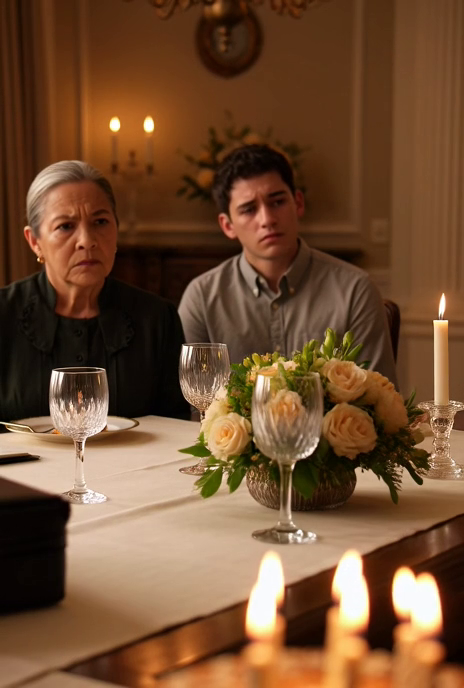
The conversation had drawn an audience.
Lena, seventeen, stood at the kitchen entrance in her oversized sweatshirt.
Theo, fifteen, appeared beside her, his headphones hanging around his neck.
“Dad?” Lena asked.
“What’s happening?”
Ian rubbed his forehead.
“Your mother and I are having an adult conversation.”
“About a divorce?”
Nobody answered.
Lena looked at me, then at her father.
I saw the moment she understood.
I had spent years protecting my children from ordinary disappointments.
Forgotten birthdays.
Broken promises.
Small arguments that seemed easier to handle privately.
But there was no way to protect them from what Ian had done in front of them.
I placed the baster beside the sink and turned off the burner beneath the gravy.
Then I untied my apron.
I folded it once and held it out to Judith.
“Let your new daughter-in-law cook.”
Judith recoiled as though I’d handed her something filthy.
“Mara, don’t be dramatic.
We have people coming.”
“Then you’d better start checking the potatoes.”
Ian stepped forward.
“You can’t just walk away.”
I looked at him.
“You just told me you’re leaving our marriage.
Surely you can survive one meal without me.”
I kissed Lena and Theo and explained that I was going to Aunt Rebecca’s house.
I told them I loved them, that none of this was their responsibility, and that I would call once I arrived.
Then I took my purse, coat, and keys.
Ian followed me into the hall.
“We’ll need to discuss practical arrangements tomorrow,” he said.
“Send me an email.”
I walked outside into the cold November air and closed the door behind me.
The first call came seven minutes later.
I ignored it.
The second came before I reached my sister’s street.
By the time I parked, I’d received nine calls and four messages.
At first, I assumed Ian regretted the timing.
Perhaps the children were upset.
Perhaps his father had finally confronted him.
Then, at 11:42, Theo sent a text.
“Mom, why is Grandma telling Dad you have to sign away Grandpa’s old shop before Monday?”
I read it three times.
My father’s shop?
That building had belonged to my family long before Ian came into our lives.
Seven years earlier, my father, Patrick Moreno, had died after operating a small printing business for almost four decades.
His brick commercial building on Alder Street was one of the few substantial things he left behind.
I had inherited it in my name.
When Ian needed office space for his remodeling company, I offered him the building at a reduced rent.
We signed a lease and agreed that the arrangement would help his business establish itself.
He often joked that the shop was our retirement fund.
I always corrected him gently.
It was my father’s legacy, and I intended to preserve it.
Now Theo was telling me Ian had plans to sell it.
My next message arrived before I could reply.
It was a photograph of a document