oversight and verified payment procedures.’
She was quiet for a moment.
‘Can I ask something?’
‘Of course.’
‘Why did you help us? Your sister was the one running the place.’
I considered the question.
I could have told her about federal accounting requirements or the responsibilities of a compliance professional.
All of those things were true.
But they weren’t the whole answer.
‘Because the money was meant for you,’ I said.
‘And someone needed to care whether it reached you.’
Aisha thanked me.
I didn’t tell her how much that conversation meant.
For most of my life, my relatives had treated my ability to solve problems as a resource they could claim whenever they wanted.
Aisha didn’t demand anything.
She didn’t pretend I owed her a personal sacrifice.
She simply wanted the opportunity she had been promised.
That difference stayed with me.
More than a year after the dinner, the criminal proceedings reached their final stages.
Following guilty pleas and sentencing proceedings, Celia received a federal prison sentence.
My father also received a custodial sentence for his participation.
Victor Rusk faced separate consequences for his role in the scheme.
The court imposed restitution obligations, and the recovery of misused funds and assets remained subject to legal procedures.
Not every dollar was immediately available.
Not every person received full compensation at once.
Real financial harm does not disappear just because someone is convicted.
But for the first time, the people affected were being recognized as victims rather than dismissed as administrative inconveniences.
I attended my father’s sentencing.
He looked older than I remembered.
His shoulders were rounded, and his voice had lost the authority that had filled our childhood dining room.
When given the opportunity to speak, he acknowledged participating in financial decisions that had harmed the organization and the people it was meant to serve.
He did not look at me while he spoke.
Afterward, my mother approached me in the courthouse hallway.
We hadn’t seen each other in months.
She looked tired.
‘Your father says he never meant for this to happen,’ she said.
I adjusted the strap of my briefcase.
‘He made decisions that allowed it to happen.’
She nodded slowly.
‘I know.’
Then she took a folded letter from her handbag.
‘I wrote this for you.
You don’t have to read it.’
I accepted the envelope.
It was the first time I could remember her offering me something without attaching a demand.
I read the letter that evening.
She apologized for giving Celia access to my office and for allowing my identification documents to be used without confirming my consent.
She admitted that she had treated my reliability as permission to take from me.
One sentence stayed with me.
‘I kept asking you to be the understanding one because I knew your sister would never make things easy for us.’
That was as close as my mother had ever come to naming what had happened throughout our childhood.
I didn’t forgive her immediately.
I also didn’t tear up the letter.
I placed it in a drawer and allowed myself to decide, without pressure, what kind of relationship I wanted in the future.
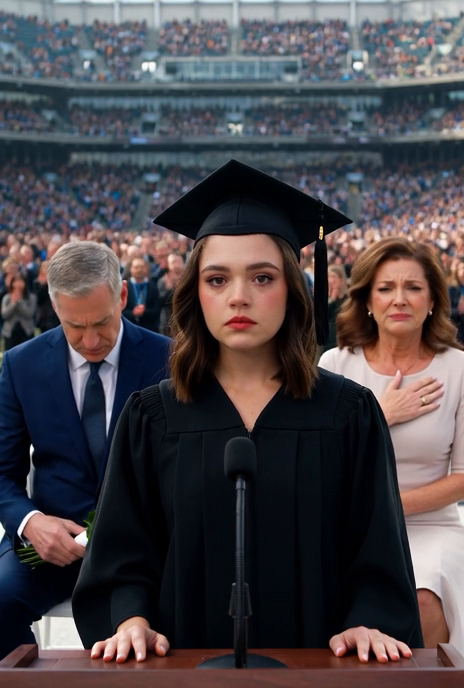
Fourteen months after the dinner, I attended a small graduation ceremony at a community workforce center.
Aisha had completed a training program through the replacement