The first sound I heard when I entered Harbor County Courthouse was my father’s laughter.
Not loud laughter.
Thomas Miller was too careful for that.
It was the short, contemptuous chuckle he had used since I was seventeen whenever I did something he considered dramatic, foolish, or disobedient.
I had heard it when I applied to the Naval Academy.
I heard it again when I entered special operations training years later.
And now, at forty-three years old, after more than two decades in uniform, I heard it while walking into court to defend the home my grandfather had left me.
My name is Evelyn Carter.
I retired from the Navy as a Commander after a career that took me from the Pacific to places I still don’t discuss in casual conversation.
During one operation in Yemen, my team helped extract forty-three trapped Americans and allied personnel after their evacuation route collapsed.
I received the Silver Star for what happened during those hours.
I rarely spoke about it.
My father spoke about it even less.
To him, military service was not sacrifice.
It was the reason I had failed him.
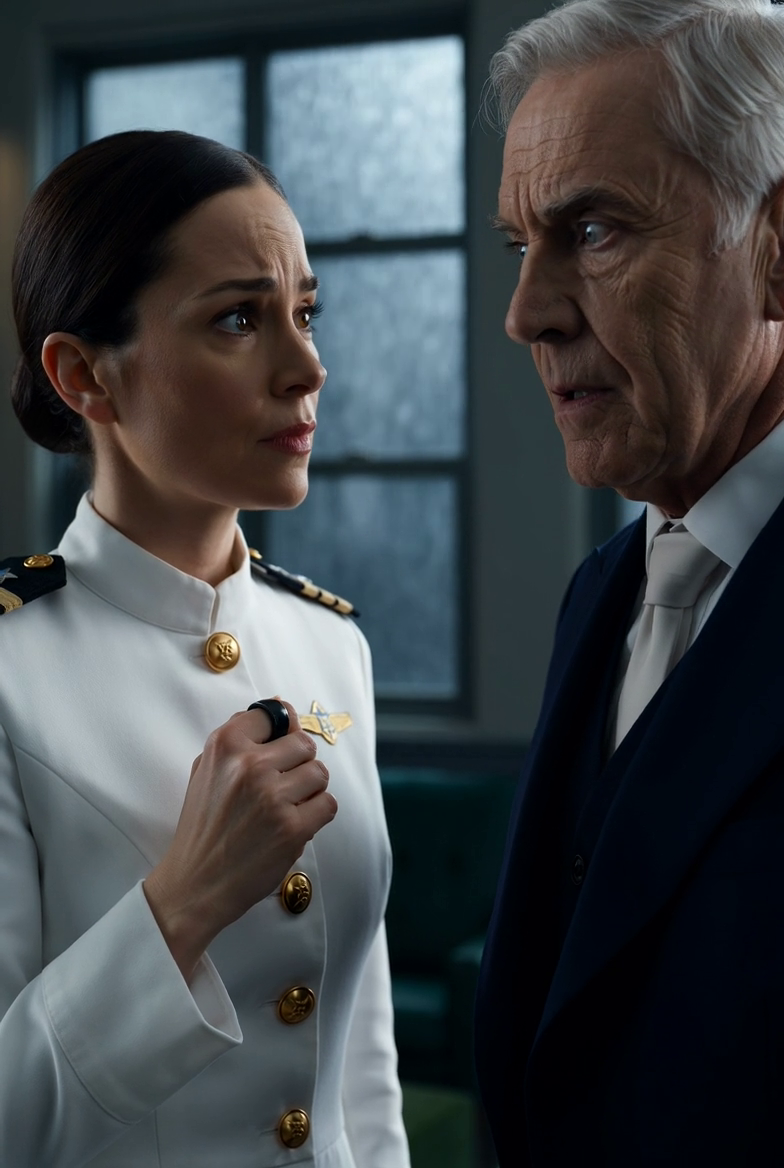
I crossed the courtroom in Dress Whites, stopped beside my attorney, Rachel Moreno, and placed my cover carefully on the table.
Across the aisle sat my parents.
Dad leaned toward my mother.
“Still playing soldier,” he murmured.
Martha Miller lowered her eyes.
That hurt more than the insult.
For twelve years, my parents had told anyone who listened that I had abandoned the family.
According to the petition they filed after my grandfather’s death, I had disappeared into military life, ignored Samuel Carter in his old age, and returned only when I discovered that his oceanfront property had become extraordinarily valuable.
The estate sat on seventy acres of rocky coastline outside Port Mercer.
There was a cedar house, a workshop, two weather-beaten barns, a boathouse, and a strip of undeveloped land developers had been trying to buy for years.
My grandfather never cared what it was worth.
Neither had I.
It was the place where he taught me to tie knots, repair an engine, cook fish over driftwood, and sit silently when words would only make grief worse.
When I was nineteen and terrified that the life I wanted would cost me my family, Grandpa Samuel told me, “People who love you don’t make you shrink so they can feel taller.”
I carried that sentence through every deployment afterward.
The bailiff called the case.
“Miller versus Carter.”
Judge Arthur Bell entered, and everyone rose.
He was in his late sixties, silver-haired, deliberate, with the expression of a man who disliked wasted words.
He sat, reviewed the first page of the file, and nodded toward my parents’ attorney.
Mr.
Hollis stood.
“Your Honor, this is fundamentally a case about exploitation.
Samuel Carter was an elderly widower whose granddaughter had been absent from ordinary family life for approximately twelve years.
Shortly before his death, Commander Carter emerged as the primary beneficiary of property worth several million dollars.
Her parents, who remained geographically and emotionally available to Mr.
Carter, were effectively disinherited.”
I looked at Dad.
He smiled.
The story sounded almost reasonable when spoken calmly.
That was what frightened me.
Hollis continued.
“We intend to show undue influence, estrangement, and circumstances suggesting that