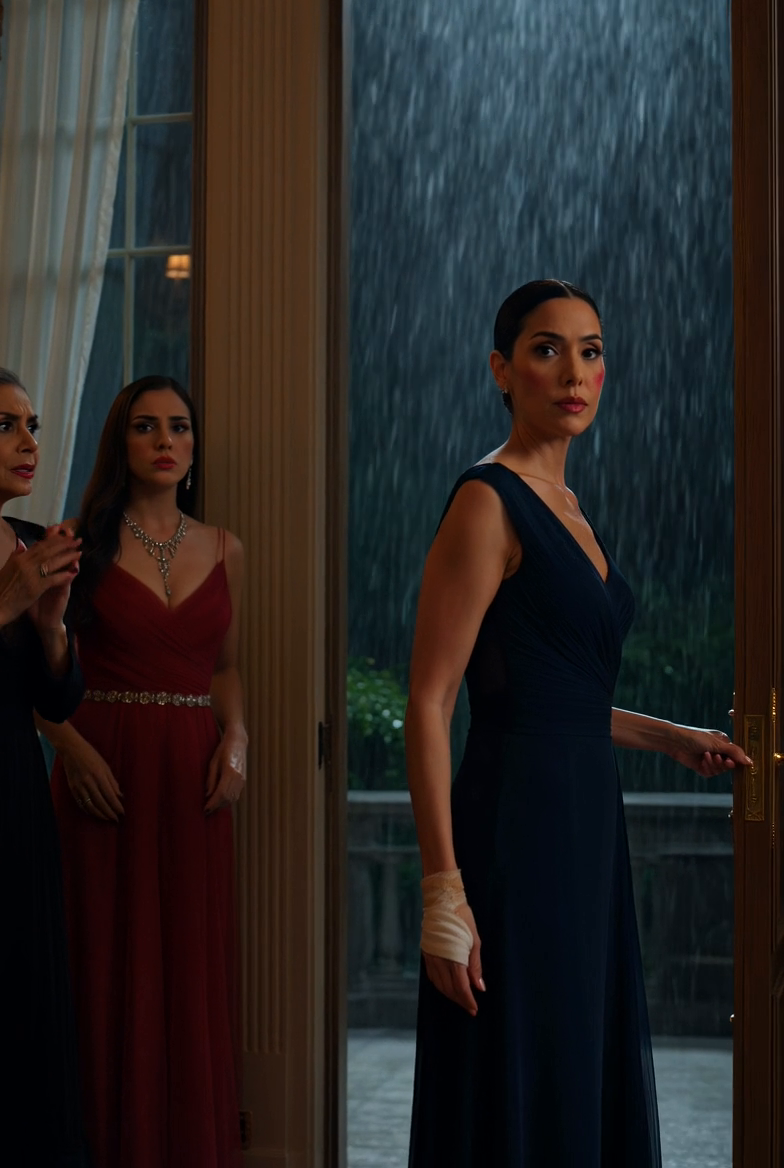
My mother’s hand struck my face so hard that one of my earrings tore free and landed somewhere in the gravel.
The sound cracked across the wedding lawn, cutting through the violin quartet and the cheerful chatter of two hundred guests.
For one terrible second, nobody moved.
Then my mother pointed toward the iron gates.
“Get out if you want to defend that old beggar.”
I stood beneath the afternoon sun, one hand pressed against my burning cheek, while my brother Daniel watched from beneath the white-and-gold wedding arch.
His custom tuxedo fitted perfectly.
His expression was carefully blank.
Behind me, my seventy-eight-year-old grandfather sat on a folding chair beside two green catering bins.
They had placed him there because my mother considered him an embarrassment.
Six hours earlier, he had flown across the country to attend his grandson’s wedding.
He arrived wearing a dark wool coat, carrying a scuffed leather bag, and walking with the slight stiffness of a man whose knees had begun to complain about the weather.
He had hugged me first.
“You look strong, Mira,” he said, holding my shoulders.
“That matters more than pretty.”
I had smiled because I knew what he meant.
My grandfather, Arthur Whitmore, had always valued character over appearances.
He never raised his voice to impress anyone, never bought something merely because other people would recognize its price, and never treated a person’s worth as a calculation of their bank balance.
My mother, Elena, considered all three habits unforgivable.
She approached us in a champagne-colored dress, diamonds flashing at her throat.
“Arthur, what are you wearing?” she asked.
He glanced down at his coat.
“Clothes, Elena.”
A nearby guest laughed nervously, unsure whether he had made a joke.
My mother didn’t laugh.
“The family is seated near the arch.
Your place isn’t over there.”
Grandfather looked toward the rows of white chairs reserved for the groom’s relatives.
“I assumed I was family.”
Her smile tightened.
“We have important guests.
Investors.
Business associates.
People who expect a certain standard.
We don’t need anyone asking why Daniel’s grandfather looks homeless.”
I felt my stomach turn.
“Mom, stop it.”
She ignored me and signaled to the wedding planner.
“Put him somewhere out of the photographs.”
The planner hesitated.
“Mrs.
Whitmore, perhaps we could arrange a seat near the side aisle?”
“I said somewhere out of the photographs.”
A server dragged a folding chair across the gravel path and set it beside the catering bins, where discarded napkins and crushed flower stems collected in the heat.
My grandfather watched the chair arrive without protest.
Then he picked up his leather bag and moved toward it himself.
That was what hurt most.
He didn’t argue.
He didn’t remind my mother that he had once carried her through a flooded street when she was a child.
He didn’t tell her that he had paid for her wedding decades earlier or that he had spent years quietly helping our family whenever disaster threatened.
He simply sat down.
I followed him.
For ten minutes, I remained beside him while wealthy guests passed with glasses of champagne and plates of shrimp.
Several glanced at us, recognized the situation, and looked away.
My father, Richard, stood near the bar adjusting his cuff links.
He saw me sitting with Grandfather and immediately