The night my son asked me to risk my home for his business, he did not know I had finally learned the difference between helping him and protecting him from himself.
For years, I had confused the two.
My name is Eleanor Mercer.
I was sixty-three when the dinner happened, a little more than eighteen months after my husband, Daniel, died.
We had lived in the same Back Bay brownstone in Boston for thirty-seven years.
Daniel bought it when the neighborhood still felt less polished than it does now, and we spent decades turning its narrow rooms into a home.
Our son, Miles, learned to walk in the front parlor.
He broke a window with a baseball at eleven and hid behind the basement stairs because he was sure Daniel would be furious.
At seventeen, he sat on the top step until two in the morning after his first serious breakup.
At twenty-two, he returned from college with three suitcases, no job, and the certainty that his life was already behind schedule.
The house had held every version of him.
It had held every version of me too.
That Sunday in February, snow had been falling since noon.
I spent most of the afternoon cooking because cooking was what I did when I missed Daniel too much to sit still.
I roasted salmon, baked potatoes with rosemary, and opened a bottle of pinot noir Miles liked.
At six forty, the bell rang.
Miles stood outside in a charcoal overcoat with Camille beside him.
She was his fiancée of almost a year, polished in the way some people seem polished even during bad weather.
Her hair was untouched by the snow.
Her boots were spotless.
Her expression was pleasant without being warm.
Miles hugged me with one arm.
Camille stepped inside, glanced around the foyer, and said, “The prices on this block are unbelievable now.”
I looked at her.
“Hello to you too.”
She laughed as though I had made a joke.
Miles did not.
That was my first clue.
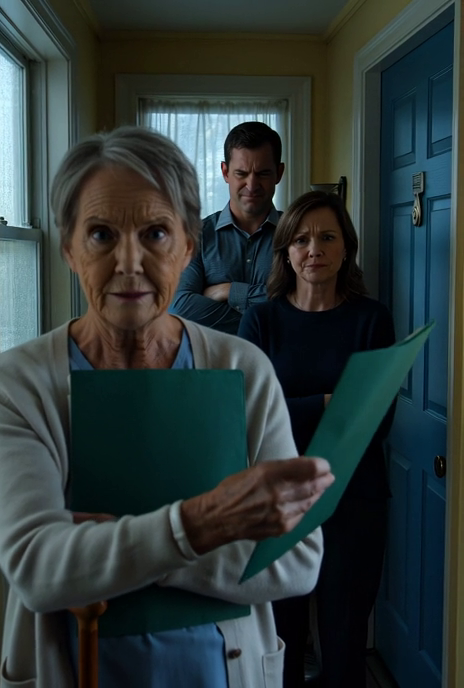
The second was the leather folder under his arm.
I had seen too many folders like it during Daniel’s illness—estate plans, medical authorizations, insurance forms.
Legal paper has a particular stillness to it.
It enters a room before anyone explains why.
At dinner, neither of them ate much.
Miles asked whether I had thought about staying longer at our cottage in Maine once spring arrived.
“Maybe,” I said.
“Why?”
“You always seem happier there now.”
“Sometimes.”
“And this house is a lot for one person.”
I set down my fork.
Camille reached for her wine.
“Miles,” I said, “what is in the folder?”
He looked at Camille, then back at me.
“I wanted to wait until after dinner.”
“I’m finished.”
He exhaled, moved his plate aside, and opened the folder.
“The Cambridge expansion is ready to close,” he began.
“Mostly.”
Mostly.
I knew that word.
Miles had built his adult life on mostly.
Mostly funded.
Mostly profitable.
Mostly temporary.
Mostly under control.
He had opened his first restaurant three years earlier.
It had done reasonably well, partly because the location was good and partly because Miles was charismatic enough to make customers feel as though they were dining somewhere important.
He had a gift for ideas, for presentation, for convincing people